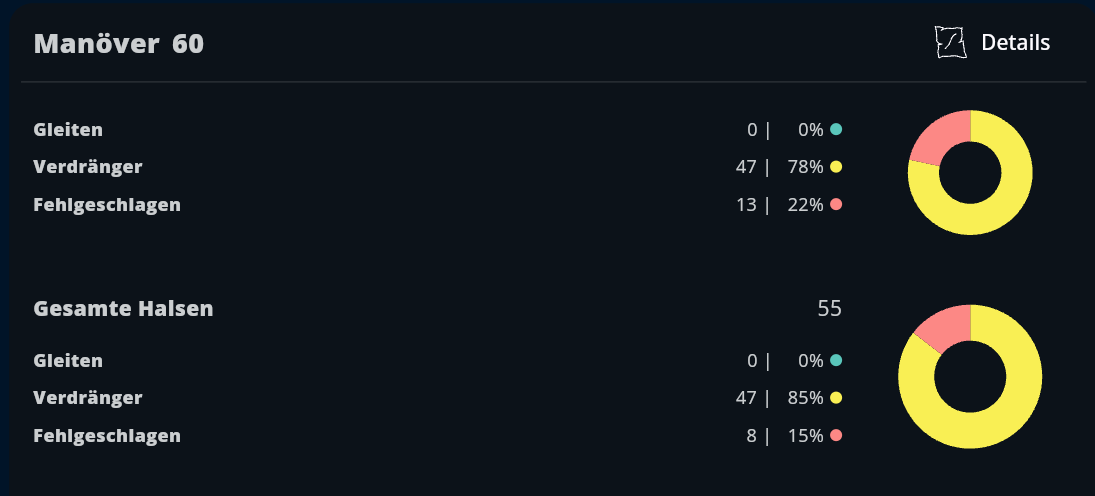
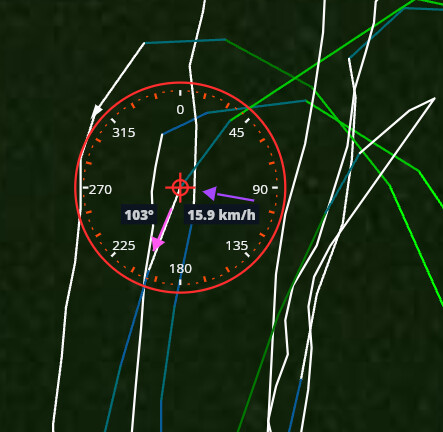
you’re definitely on the right track! The algorithm for planing gybes is based on planing speed – in windsurfing, the threshold is around 18 km/h, with a little tolerance for GPS inaccuracies. The gybe in your screenshot shows 15.9 km/h, which is unfortunately just below the threshold.
The good news: you’re already right on the edge. Here are a few tips to help you stay above it more often:
More speed before the gybe – the faster you enter, the more of a buffer you have
A wider radius – this keeps the board gliding smoothly for longer
Don’t rush the sail flip – if you enter with speed, you’ll have more time for it
In the screenshot, it looks like you’re heading up too sharply during the sail flip – that kills your speed and costs you exactly the momentum you need.
One more question: Which device are you using to record your sessions, and where are you wearing it? That can also affect the measured values.
Good luck – I’m sure your first cleanly recorded planing gybe is just around the corner!
The position is unfortunately not ideal – in the inner pocket of the flotation vest, the phone has no clear line of sight to the sky, and the vest itself also shields the GPS signal. That can noticeably affect measurement accuracy.
Theoretically, the best position would be on your head, but that’s obviously impractical . An upper arm pocket, as close to the shoulder as possible, would be significantly better. We’ve had good experience with Fidlock pockets – they close tightly and stay secure.
Important: Today’s smartphones are usually waterproof themselves, so the most important point is actually that the pocket doesn’t lose the device – and that’s where Fidlock has proven itself.
However, a better position is no guarantee that your speed will be within the tolerance range on the next jibe – that still depends primarily on your riding style.


 . An upper arm pocket, as close to the shoulder as possible, would be significantly better. We’ve had good experience with Fidlock pockets – they close tightly and stay secure.